
Although Copenhagen Fashion Week is a relatively new event in its current form, its roots can be traced back to two major clothing trade fairs: Dansk Modeuge (Danish Fashion Week) and Dansk Herremodeuge (Danish Men’s Fashion Week), which were established in the 1950s. These events showcased Danish designers and garment producers to regional buyers and press.
In 2005, the Danish Fashion Institute (DAFI) was founded to promote Danish fashion design both nationally and internationally. One of the Institute’s first initiatives was merging Dansk Modeuge and Dansk Herremodeuge into Copenhagen Fashion Week (CPHFW), establishing a unified fashion week for the Danish and broader Nordic fashion industries. The inaugural Copenhagen Fashion Week was held in 2006.
After its founding, CPHFW steadily grew in scope and reputation, drawing international buyers, press, and brands. Throughout the 2010s, CPHFW became recognized as the largest fashion event in Northern Europe. CPHFW distinguishes itself from other fashion weeks by focusing on functional, contemporary designs that align with the instantly recognizable Nordic style. Rather than competing with the “Big Four” fashion weeks in New York, London, Milan, and Paris, CPHFW has found a unique niche, enabling it to thrive.
Another distinguishing feature of CPHFW is its strong focus on sustainability. In 2020, CPHFW introduced the Sustainability Action Plan, the first of its kind among major fashion weeks. This plan implemented minimum environmental and ethical requirements for participating brands, positioning CPHFW as a leader in sustainable fashion practices.
CPHFW also supports emerging Nordic designers and brands through its CPHFW NEWTALENT program. During Copenhagen Fashion Week, the program gives three to five brands with less than five years in the fashion business the opportunity to showcase their collections in showrooms. The program also provides monetary and PR support, as well as mentorship and networking opportunities.
Copenhagen Fashion Week is held twice a year, in January/February and August. Its programming features runway shows, trade fairs, exhibitions, talks, presentations, and hundreds of other events and activities for industry stakeholders and the general public.
Each year, CPHFW showcases Nordic and international brands, both established and emerging. The lineup for Copenhagen Fashion Week AW26, for example, included Aiayu, Baum und Pferdgarten, Caro Editions, Fine Chaos, Forza Collective, Gestus, Henrik Vibskov, Herskind, Holzweiler, MKDT Studio, Nazzal Studio, Nicklas Skovgaard, O. Files, OpéraSport, Paolina Russo, Ranra, Rave Review, Skall Studio, Sson, Studio Constance, Sunflower, Taus, and The Garment. Several brands were also showcased via the CPHFW NEWTALENT program: Anne Sophie Madsen, Bonnetje, and Stem.
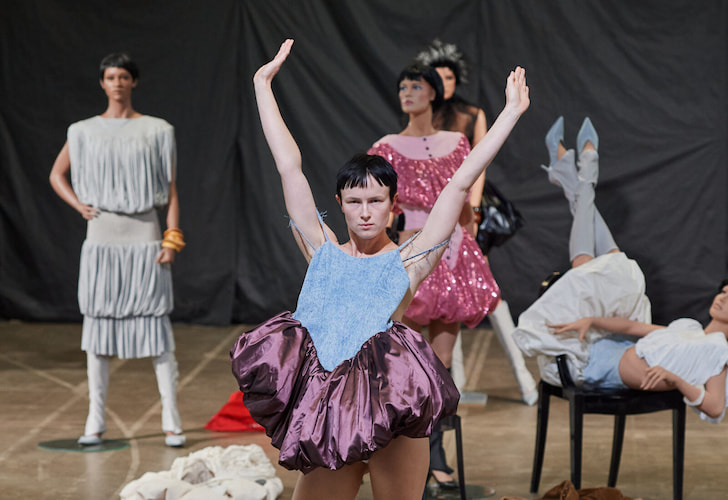
Photo: сopenhagenfashionweek.com


