
While fashion shows date back to the late 1800s, when French couture houses began holding biannual demonstrations of their collections, New York Fashion Week is considered the world’s first fashion week. It was founded in 1943 by American fashion publicist Eleanor Lambert.
Lambert’s main goal was to offer American fashion buyers an alternative to French fashion during World War II, when travel to Paris was restricted, and to promote the American fashion industry by showcasing American designers. The first New York Fashion Week, held in July 1943, was originally called “Press Week”. It was a huge success, leading to increased representation of American fashion in leading fashion magazines such as Vogue.
By the mid-1950s, the event had become known as the Press Week of New York. It featured numerous fashion shows held in various locations throughout New York City, including department stores, galleries, lofts, and nightclubs.
In 1962, Lambert founded the Council of Fashion Designers of America (CFDA) to support and promote the American fashion industry. In 1993, the CFDA consolidated the scattered shows, which were informally called New York Fashion Week by that point, into a centralized event held under large tents at Bryant Park and branded as “7th on Sixth”. This made it easier for buyers, the press, and industry professionals to attend multiple shows. The consolidation and move to Bryant Park are often viewed as the birth of the modern NYFW.
IMG acquired “7th of Sixth” in 2001 and has owned and produced New York Fashion Week ever since. NYFW was held as a consolidated event until 2016, moving to Lincoln Center in 2010 to accommodate larger-scale shows, then to Skylight Clarkson Square in 2015. In 2017, IMG returned to a decentralized format with Spring Studios in Lower Manhattan serving as the main venue.
Today, New York Fashion Week is one of the world’s premier fashion events, alongside fashion weeks in Milan, Paris, and London. These four fashion weeks are collectively known as the “Big Four”. NYWF is the most commercially oriented of the Big Four fashion weeks; it places a stronger emphasis on wearability and caters to buyers from major global retailers and department stores.
Culturally, NYFW has a long tradition of showcasing emerging and immigrant designers and labels outside the traditional European fashion establishment. Streetwear, sportswear, and hybrid high-low aesthetics are more widely represented in New York than in other fashion capitals, reflecting the city’s broader cultural identity.
New York Fashion Week typically opens the Big Four fashion season, preceding the fashion weeks in London, Milan, and Paris. It is held in February for the upcoming fall/winter collections and in September for the upcoming spring/summer collections.
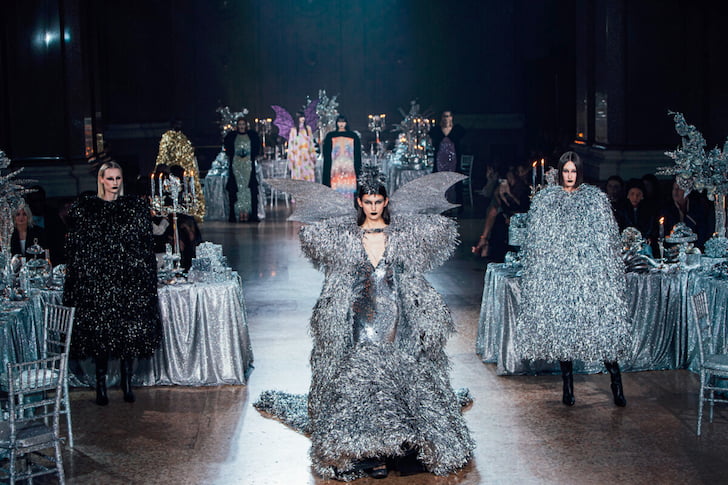
Photo: nyfw.com


