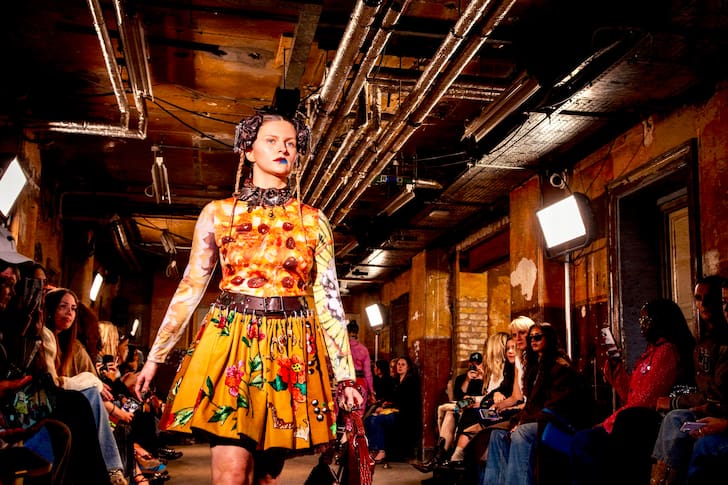
London Fashion Week’s history is closely linked to that of the British Fashion Council (BFC). The BFC was founded in 1983 to enable the sustainable growth of the British fashion industry and promote British fashion in the UK and abroad. The idea to consolidate London’s fashion shows into one event belonged to communication strategist Lynne Joanne Franks, who started her own PR agency at the age of 21 and worked with many fashion brands and designers.
In 1984, Franks approached the Murjani Corporation, owner of the Gloria Vanderbilt jeans brand, with a proposal to sponsor a fashion event outside the Commonwealth Institute in Kensington, where British designers could exhibit their collections. With the support of the BFC and the Murjani Corporation, a group of British designers and producers organized the inaugural LFW, which featured 15 catwalk shows from designers and brands such as David Fielden, John Galliano, Ghost, Betty Jackson, and Vivienne Westwood.
Over the next two decades, LFW became known for its creative spirit and for showcasing young, avant-garde British designers. LFW helped launch the careers of Stella McCartney, Alexander McQueen, and other renowned international talents.
Since its inception, LFW has secured its position as one of the “Big Four” fashion weeks, which are considered the world’s most significant fashion events. Each of these fashion weeks is thought to have a unique character. New York Fashion Week is the most commercially oriented; Milan Fashion Week is associated with craftsmanship and luxury; Paris Fashion Week emphasizes fashion as an art; and London Fashion Week is associated with creative risks and bold experimentation. In 2010, LFW became the first of the “Big Four” weeks to offer designers the opportunity to stream their shows online.
LFW has changed venues several times since its inception. Past official venues include the Duke of York’s Headquarters, Olympia London, the Ritz Hotel, the Natural History Museum, Battersea Park, Somerset House, Brewer Street Car Park, and The Store Studios at 180 The Strand. Today, LFW is a decentralized event, with shows held at multiple venues across the city. These venues include historic institutions, cultural landmarks, galleries, museums, and urban spaces, with The Store Studios functioning as LFW’s hub.
Like all major fashion weeks, LFW is an exclusive, invitation-only event for industry professionals and the press. It attracts more than 5,000 journalists and buyers every year. However, there are events for the general public as well because LFW is immediately followed by the London Fashion Week Festival, formerly known as the London Fashion Weekend. This retail-focused, ticketed event features catwalk shows, talks, and pop-up shops that showcase more than 150 British and international brands to consumers.