Linear vs Rotary Stretch Blow Molding Choosing the Right Platform for Your Plant
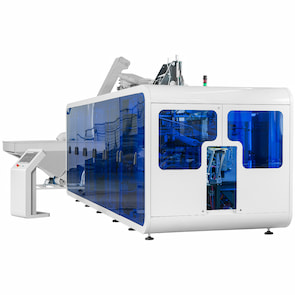 For a client only starting their blow molding and PET manufacturing journey, there could be some elements in the industry that are not obvious, for example, what linear (automatic) and rotary stretch blow molding platforms are and how to choose the right one.
For PET Technologies it’s also true. Sometimes we receive requests without a clearly defined machine, but it is our duty to assist each of them and find the best personalized solution for our clients, while explaining the difference between the blow molding machine types. PET Technologies is a manufacturer of blow molding equipment, both linear and semi-automatic.
Differences between linear and rotary stretch blow molding platforms.
Both platforms fundamentally do the same: they produce PET bottles through a 2-stage stretch blow molding process. But in this comparison, PET Technologies helps you clarify how linear and rotary stretch blow molding systems differ in throughput, flexibility, and maintenance requirements. Ensuring the right choice for your plant and your production goals.
The main difference between linear machine and a rotary machine lies in motion principle:
- Linear platforms process preforms in indexed steps. Groups of preforms are heated, stretched, and blown in cycles where motion stops and starts. The number of cavities is between 2 and 10. The layout of PET Technologies linear blow molding machines is straightforward and modular.
- Rotary platforms use continuous motion. Preforms travel in a circle around a blowing wheel. Each cavity handles one preform per rotation with synchronized stretch and blow operations. The number of cavities increases greatly too, up to 20-30 and more. This produces a continuous cycle.
Production rate and throughput comparisons for plant planning.
When you evaluate your production strategy, expected throughput often becomes the primary decision factor.
- Linear systems are commonly used for mid-sized production volumes. For example, the productivity of PET Technologies automatic linear blow molding machines ranges from 3,000 to 14,000 bottles per hour for a 1.5L bottle. These numbers allow producers who trust PET Technologies to achieve stable output and the promised number of bottles in manufacturing environments.
- Rotary systems are optimized for high-volume production, where the aforementioned continuous motion maximizes output. Such a solution is not for everyone; in addition to much greater costs for the rotary equipment, this solution is typically used at large production facilities, such as a large beverage plant of a multinational corporation.
Operational considerations: maintenance, footprint, and flexibility.
Beyond speed, a well-informed comparison for clients must also consider maintenance, as this often becomes a major cost after the sale for some equipment producers, as well as layout, since linear and rotary machines differ vastly in their size and flexibility, with one being larger than the other:
Maintenance: A linear platform from PET Technologies offers clients much easier access to core components, with access from both sides and fewer synchronized moving assemblies. Maintenance procedures for PET Technologies clients are not only more straightforward, but much easier. The continuous motion architecture and increased number of blow molds makes rotary machines much harder to maintain.
Footprint: In general, linear machines have a smaller footprint for client’s plant layouts compared to rotary machines.
Flexibility: If you have a product line that is bigger than one, and you have bottles with:
- Different volumes
- Bottle shapes
- Bottle neck
And if you do frequent format changes, then linear machines from PET Technologies are the right choice!
Quick neck changeover on the APF-Max machine and fast mold changes thanks to the trolley have greatly increased productivity for many thankful clients of PET Technologies who use APF-Max machines. Plus, with solutions like APF-Max 3U, clients such as PET bottle producers for sale can change formats on one machine from 0.1L to 10L by changing the number of molds.
Rotary platforms excel at stable, large-scale production of a few formats, where volume and speed dominate your strategy.
Conclusion
The comparison between linear and rotary stretch blow molding solutions highlights two different technological approaches within PET manufacturing. A linear platform emphasizes modularity, operational flexibility, and accessible maintenance. A rotary platform prioritizes continuous motion and elevated throughput for high-capacity production.
Breadcrumbs
Tags