The word Awussu (spelled Aoussou or Aouessou in French) comes from the Sicilian word augustu or the Latin Augustus, both of which mean “August”. It refers to the hottest period of the year according to the traditional agricultural calendar, which usually occurs in July and August and lasts for approximately forty days.
Many sources claim that the carnival’s origins can be traced back to the Neptunalia, a two-day festival honoring the Roman god Neptune, which was held around June 23, with some even claiming it dates back to the Phoenician period. Since present-day Tunisia was once a Roman province, it is indeed possible that the Neptunalia was celebrated there at some point.
However, the Carnival of Awussu has only been held since the mid-20th century, and there is no reliable evidence that it developed from the Neptunalia. Nevertheless, the organizers present the carnival as a continuation of the Neptunalia that has lost its religious connotations and use an image of Neptune in the carnival logo and one of its signature floats.
The first edition of the Carnival of Awussu took place in 1958. According to the Awussu Carnival Association, it was the first carnival in Africa and the Arab world. The carnival was held regularly until 2010, becoming a major tourist attraction for Sousse during the summer holiday season. During that period, the carnival was often used for government propaganda. However, it went on hiatus due to the Tunisian Revolution.
The return of the Carnival of Awussu was announced in 2014 but was postponed until 2015 due to organizational and financial issues. There also appears to have been another hiatus from 2019 to 2022, as the official website of the Carnival of Awussu lists the 2018 carnival as the 59th edition and the 2023 carnival as the 60th. The event was likely canceled due to the COVID-19 pandemic, though the reason for its cancellation in 2019 is unclear.
The Carnival of Awussu takes place in the second half of July and culminates on Republic Day. This Tunisian public holiday is celebrated on July 25 to commemorate the proclamation of the republic on that date in 1957. Although the carnival is still centered around Republic Day, its focus has shifted from politics to culture and tourism since the revolution.
The centerpiece of this vibrant celebration is a festive procession featuring brass bands, folk groups from Tunisia and other countries, dancers, giant puppets, and elaborately decorated floats. The procession marches along the coastal boulevard overlooking Boujaafar Beach, attracting around 60,000 spectators. Another highlight of the carnival is the spectacular fireworks display on Republic Day. The carnival program also includes street art performances and other festive events and activities.
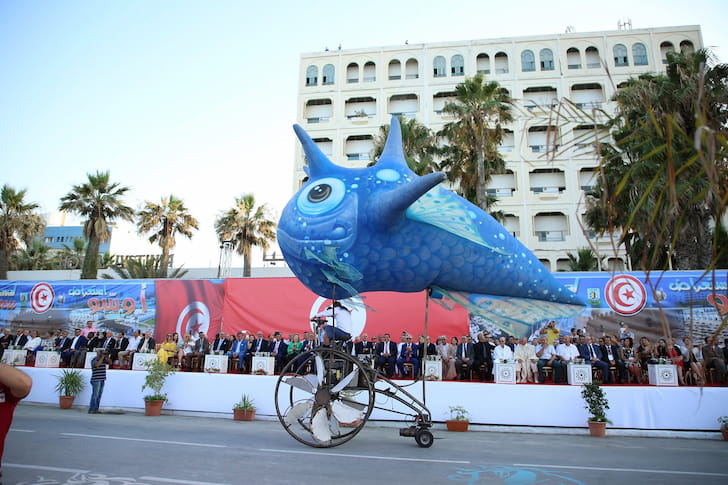
Photo: carnavalaoussou.com


