
The German carnival season usually begins on November 11 and culminates on Shrove Monday the following year, known as Rosenmontag. This means that all major German carnivals occur around the same time, so tourists must choose which one to attend. For this reason, the organizers of the Bremen Carnival chose different dates for their event.
The Bremen Carnival was founded in 1985 by members of the “1st Bremen Samba Group”, led by Swiss artist Janine Jaeggi, who has served as the carnival’s artistic director since its inception. The founders combined the traditional Rhineland Carnival, with its parades and costume balls, with samba dancing, which is commonly associated with Caribbean carnivals.
The first carnival parade was held on February 15, 1986, in Bremen’s Ostertor district, featuring a samba group and around 100 participants. In its first few years, the carnival was held on the first full moon night in February to distinguish it from the Rhineland Carnival. However, this did not prevent scheduling conflicts, so the organizers eventually settled on the weekend before the major Rhineland Carnival parades. However, there have been some exceptions: due to the disruptions caused by the pandemic, the carnival was held in July and April in 2022 and 2023, respectively. The pandemic also resulted in the cancellation of the traditional carnival parade and street festivities in 2021.
The new carnival grew rapidly in subsequent years, reaching its current form by 1991. It evolved from a small street parade into a vibrant celebration featuring colorful costumes, percussion groups, street theater performancess, and samba groups from Germany and neighboring countries. Today, the Bremen Carnival is widely regarded as one of the largest samba carnivals in Europe.
Thanks to its convenient timing and unique atmosphere, the Bremen Carnival draws approximately 1,500 participants and over 30,000 spectators each year, despite the cold weather. While the samba parade is the main highlight, there are plenty of other events to enjoy, such as a children’s carnival, a masquerade ball, and various concerts and exhibitions. Some events are free, while others require paid admission.
Each year, the Bremen Carnival has a new theme, announced during the official opening of the carnival season on November 11 of the preceding year. The theme is often social or political. For instance, the theme in 1991 was “Rebelling Against War” (Aufbrodeln gegen den Krieg), in response to the Gulf War.
The Bremen Carnival should not be confused with the Bremen Freimarkt (Bremer Freimarkt), an annual funfair held during the second half of October. Both events are iconic, but the Freimarkt is significantly older, dating back to 1035.
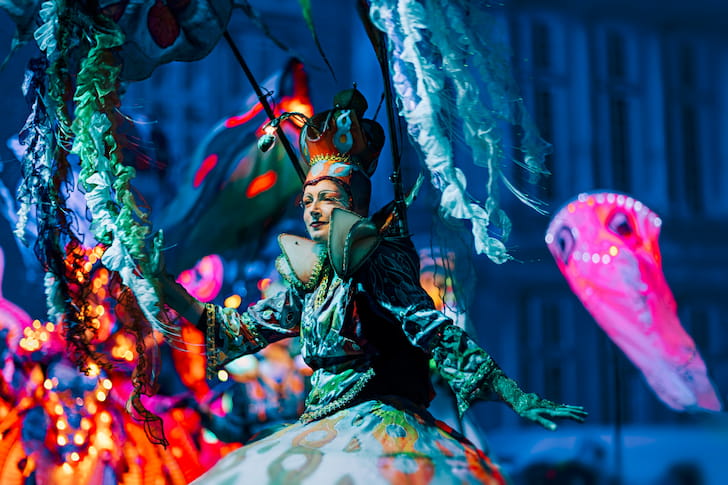
Photo: bremer-karneval.de


