
The exact origins of flower parades are unclear, but they became popular in some parts of Europe in the mid-to-late 19th century. The Legden Flower Parade, also known as the Legden Dahlia Parade, is slightly younger, but still long-standing: it celebrated its centenary in 2026.
The driving force behind the Blumenkorso Legden was Theodor Entrup, a local vicar with a passion for flowers, especially dahlias. One evening, while sitting with friends at an inn, he read in a newspaper about a flower parade being held in Nice (Bataille de fleurs). Inspired by the idea, he suggested to his friends that they organize a similar event in Legden. Although his friends were initially skeptical, even going as far as calling the idea “crazy”, Vicar Entrup was undeterred and enlisted their help.
The first Legden Flower Parade was held on October 3, 1926. It was a resounding success, attracting over 5,000 spectators. All proceeds from the event were donated toward the construction of a new hospital; the tradition continues to this day, although the causes supported by the parade have varied over the years. The next two parades attracted twice as many spectators, bringing fame to the small village of Legden beyond North Rhine-Westphalia.
The parade tradition was interrupted by World War II, and it took a decade to revive it. The first postwar parade was held in 1955. Since then, the flower parade has become an integral part of Legden’s cultural life, as well as one of the most popular events in North Rhine-Westphalia. The parade has been held every three years since 1960, except in 2020 when it was canceled due to the pandemic.
The parade floats are decorated with dahlias, a tradition that began with Entrup’s personal love for these flowers. Over time, the dahlia has effectively become the municipality’s symbol, and Legden is sometimes referred to as Dahliendorf (“dahlia village”). In 2000, the Blumenkorso association decided to allocate some of its proceeds to a dahlia garden that would finally open in 2015.
The Blumenkorso Legden floats are made by neighborhood groups called Wagenbaugemeinschaften. These groups spend months designing the floats, which are decorated with fresh flowers shortly before the parade. The floats usually have a theme and often depict characters from popular media, such as Harry Potter, Alice in Wonderland, Madagascar, and The Lion King.
One unusual tradition that sets the Legden Dahlia Parade apart from other flower processions is that only children ride the floats during the parade. Another longstanding tradition is the election of the Dahlia Queen (Dahlienkönigin), who traditionally rides on a special float. The queen’s position is associated with the festival’s cycle, so she retains the title until the next parade.
In 2026, when the event celebrated its centennial, the Blumenkorso Legden was officially recognized as an intangible cultural heritage of North Rhine-Westphalia by the state authorities.
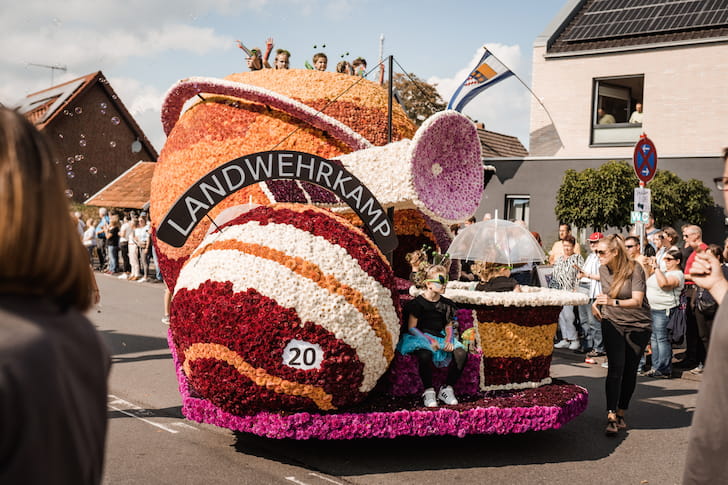
Photo: blumenkorso-legden.de


