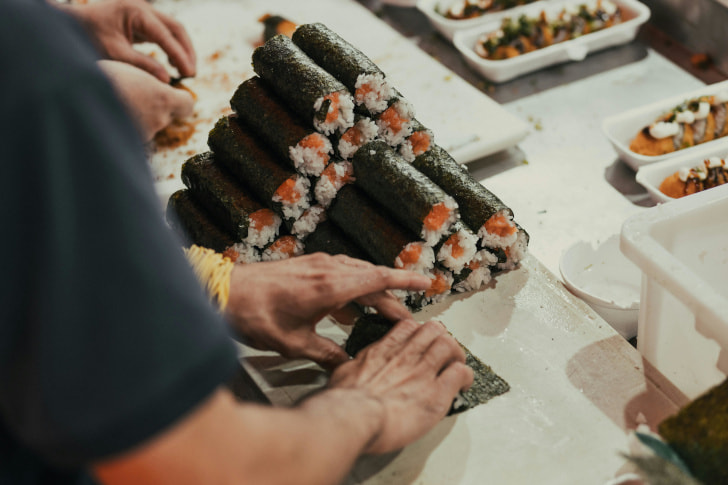
Nori is a type of dried, edible seaweed that is widely used in Japanese cuisine. Nori sheets are used to wrap sushi and onigiri, small sheets or strips of nori are used to garnish rice dishes, soups, and noodles, and nori flakes are used as seasoning.
Nori is made from red algae belonging to the genus Pyropia. The Japanese began harvesting them from the sea centuries ago, but all attempts to cultivate them failed due to a lack of understanding of the algae’s life cycle. It was not until the mid-20th century that the commercial cultivation of nori became possible, thanks to English phycologist Kathleen Mary Drew-Baker.
Kathleen Mary Drew-Baker was born Kathleen Mary Drew on November 6, 1901. She earned her bachelor’s and master’s degrees in botany from the University of Manchester, where she spent most of her career, except for a two-year fellowship at the University of California, Berkeley.
Drew-Baker studied the seaweed Porphyra umbilicalis (laver), an edible red alga found in the Irish Sea that is commonly used in Wales to make a traditional food product called laverbread. She discovered that the alga’s life cycle includes two distinct stages, alternating between the gametophyte stage and the conchocelis stage. The alga produces macroscopic haploid blades during the gametophyte stage, which are harvested for consumption, and microscopic diploid filaments during the conchocelis stage. Before Drew-Baker’s discovery, the conchocelis stage was considered a different species of algae altogether.
Drew-Baker published her research in Nature in 1949. Japanese phycologist Sokichi Segawa read her paper and realized that the red algae used to produce nori might have a similar life cycle. By the early 1960s, other Japanese marine biologists had developed artificial seeding techniques based on Drew-Baker’s research, thereby revolutionizing the Japanese seaweed industry. Having died in 1957, Drew-Baker never learned the extent of her work’s impact.
Although Drew-Baker never visited Japan or lived to see her research’s true impact on Japanese aquaculture, her scientific legacy is still revered there. In 1963, a monument to her was erected at Sumiyoshi Shrine in Uto, overlooking the nori fields in the Ariake Sea. Every April 14, the Drew Festival (Drew-sai) is held in Uto to honor her contributions to Japanese aquaculture.
The Drew Festival is a small event centered on a commemorative ceremony conducted according to Shinto practices. The ceremony includes a ritual prayer and the presentation of offerings at a shrine, as well as a memorial service. The festival does not attract many tourists. Attendees typically include local officials, seaweed farmers, and community members who wish to honor Drew-Baker’s contribution to the region’s economic revival through her discovery.