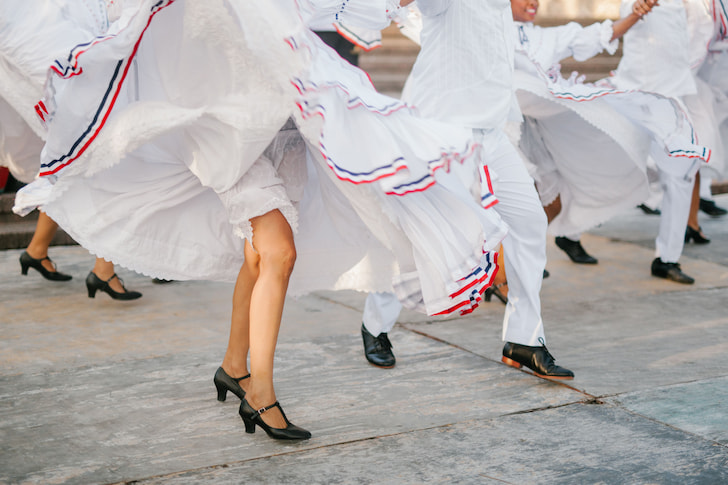
The festival was founded in 1981 by the prominent Cuban author and cultural researcher, Joel James Figuerola. Its main organizer is the Casa del Caribe, a cultural organization founded by Figuerola to study, preserve, and promote Caribbean culture. Each festival edition focuses on showcasing the culture of a particular Caribbean country, and a delegation from that country is invited as the guest of honor.
The Santiago de Cuba Fire Festival is usually held from July 3 to 9. The event kicks off with a cultural gala at the Teatro Heredia (Heredia Theater) and the Serpent Parade (Desfile de la Serpiente). The Serpent Parade is the opening procession in which all participating delegations march through the historic city center singing, dancing, and waving their national flags.
This is followed by a week of art exhibitions, cultural seminars and workshops, theater and dance performances, poetry readings, jam sessions, and religious ceremonies organized by the city’s cultural and social institutions and held in public squares, theaters, and galleries across the city. Since its inception, the Fire Festival has become one of the most important cultural events in Cuba and the entire region, drawing thousands of participants from Cuba and other Latin American countries.
One of the Fire Festival’s main distinguishing features is its academic aspect. In addition to celebrating and showcasing the many Caribbean cultures, the festival focuses on their study and preservation. For this reason, the festival program usually includes academic conferences and colloquia dedicated to Caribbean history, identity, and traditional religious practices. This combination of street parades, parties and performances with an intellectual aspect is what makes the Fire Festival truly special.
Another highlight of the Fire Festival is the Burning of the Devil (Quema del Diablo), which marks its culmination. Held on the final evening, this event combines elements of Afro-Caribbean spirituality and carnival traditions. It begins with a ritual salute to Nzambi, the supreme deity in the Afro-Cuban religion of Palo that developed in Cuba in the late 19th or early 20th century, drawing from the traditional Kongo religion of the Bakongo people in Central Africa.
After the salute, a giant effigy of the devil is ceremonially burned to the beat of drums, while fireworks illuminate the city. This ritual symbolizes the destruction of evil, misfortune, and negative influences while welcoming renewal, happiness, and communal harmony.
The Fire Festival of Santiago de Cuba is one of two major festivals held in the city in July. The other is the Santiago de Cuba Carnival, which usually culminates on National Rebellion Day, a public holiday commemorating the outbreak of the Cuban Revolution on July 26, 1953.